
1. Do Particles in Coating Slurry Affect Coating Quality?
Yes. Particles in coating slurry can significantly affect coating quality, but the impact depends on their size, shape, hardness, concentration, dispersion state, and compatibility with the coating process.
For some applications, solid particles are essential functional ingredients. Ceramic coatings, battery electrode slurries, optical functional films, and inorganic-filled adhesives may all contain deliberately added particles.
- The real problem is not simply the presence of particles. It is whether the particles are properly dispersed and compatible with the required coating thickness, coating method, and surface quality.
- When particles are too large, poorly dispersed, or contaminated by foreign materials, they can create defects that are difficult to eliminate through adjustments to coating speed or thickness alone.
- Common problems include:
- Surface protrusions: Particles or agglomerates create raised spots on the coating surface.
- Longitudinal streaks: Particles become trapped near a coating blade or die lip, disrupting the flow of slurry.
- Pinholes and uncovered areas: Local coating disruption leaves small holes or exposed substrate regions.
- Uneven coating thickness: Particle accumulation changes the local flow or metering conditions.
- Equipment blockage: Agglomerates accumulate in narrow passages, filters, pumps, or coating heads.
- Reduced production yield: Defective sections must be inspected, removed, or scrapped
These problems are particularly important when producing thin functional coatings, where even a small number of oversized particles may become visible or interfere with product performance.
For precision coating applications, understanding particle behavior before selecting the coating equipment can save substantial time during process development.
2. What Types of Particles Cause Coating Problems?
Before choosing a solution, it is important to identify what is actually present in the slurry.
2.1 Oversized Functional Particles
Some formulations intentionally contain ceramic powders, inorganic fillers, pigments, conductive materials, or other solid particles.
These ingredients may be necessary for the final product. However, if the particle size distribution is incompatible with the target wet-film thickness or coating gap, the coating may become rough or unstable.
For example, a thin coating designed for a smooth optical film may be sensitive to oversized particles that would be acceptable in a thicker industrial coating.
Recommended approach: Check the particle size distribution against the target coating thickness, the coating head geometry, and the required surface quality. Do not assume that a formulation is suitable simply because its average particle size is small.
2.2 Particle Agglomerates
Agglomerates form when smaller particles cluster together instead of remaining uniformly dispersed.
This is one of the most easily overlooked causes of particle-related coating defects. A formulation may have an acceptable primary particle size, yet still contain much larger clusters.
Agglomeration may result from:
Insufficient dispersion during slurry preparation.
Inadequate compatibility between particles and the liquid or dispersant.
Changes in pH, temperature, or solvent composition.
Prolonged storage or unsuitable recirculation conditions.
Changes in viscosity or solid content that affect dispersion stability.
Agglomerates can pass through upstream processing equipment and subsequently become trapped at a coating head or appear as defects on the finished film.
Recommended approach: Evaluate both the original particle size and the size of agglomerates present in the actual coating slurry. Improve dispersion stability rather than relying on filtration alone.
2.3 Foreign Contamination and Dried Residues
Not every particle originates from the raw materials.
Foreign particles can enter the slurry from:
Dust and airborne contamination.
Dried slurry deposits inside tanks and pipelines.
Residues from previous production batches.
Worn seals, hoses, rollers, or other equipment components.
Contaminated substrates or release liners.
Dried material around a tank outlet or coating head can detach during operation and produce sudden, intermittent defects.
Recommended approach: Inspect the complete slurry delivery path, clean product-contact surfaces, and check the substrate before changing the coating parameters.
3. How Do Particles Affect Different Coating Methods?
Particle-related defects do not behave identically across all coating technologies. A solution that works for one coating method may be ineffective for another.
3.1 Doctor Blade and Comma Blade Coating
In blade coating, slurry passes through a metering region where the blade controls the applied layer.
Oversized or hard particles can become trapped near the blade edge or between the blade and the supporting surface. Depending on the configuration, they may produce scratches, longitudinal streaks, local thickness variations, or blade wear.
Practical solutions include:
Inspecting the slurry for oversized particles and agglomerates.
Checking blade condition, alignment, and the metering gap.
Verifying that the blade and supporting roller are suitable for the formulation.
Selecting an appropriate filtration system without removing necessary functional particles.
If a streak repeatedly appears at the same cross-web position, inspect the blade edge and local contact conditions as well as the slurry.
3.2 Slot-Die Coating
Slot-die coating is widely used for precision roll-to-roll coating because the coating liquid is delivered through an internal manifold and a narrow die opening.
This makes particle control particularly important.
Agglomerates may accumulate in the internal flow path or become trapped near the die lip, disturbing the flow and creating persistent streaks or localized coating defects. Deposits and damaged die surfaces can produce similar symptoms.
Practical solutions include:
Checking the maximum particle or agglomerate size against the die's internal passages and operating gap.
Evaluating slurry filtration and dispersion stability.
Inspecting the die lip and internal flow path for deposits.
Checking for trapped air, unstable pumping, and flow-rate fluctuations.
Confirming that the formulation can pass through the selected die without unacceptable blockage or particle retention.
Important: A smaller die gap does not automatically produce a better coating. The gap, slurry rheology, particle characteristics, flow rate, and target wet-film thickness must be evaluated together.
3.3 Micro-Gravure Coating
Micro-gravure coating meters slurry through the cells of a patterned roller before transferring it to the substrate.
Particles that are too large for the cell geometry, or that accumulate at the doctor blade, may interfere with liquid transfer and cause streaks, uneven coverage, or surface defects.
Practical solutions include:
Comparing particle size and agglomerate size with the selected gravure roll geometry.
Checking whether particles accumulate in the cells or around the doctor blade.
Confirming that the slurry can be transferred consistently at the intended viscosity and speed.
Testing whether a suitable filtration or dispersion process improves coating uniformity.
For inorganic-filled formulations, particle compatibility with the gravure cell structure is particularly important.
3.4 Roll-to-Roll Coating Lines
In continuous production, a small particle-related problem can become a substantial yield issue.
A particle that remains trapped at a coating point may generate a continuous streak along the running direction. A particle that enters the coating intermittently may instead create isolated defects.
The distinction matters because the troubleshooting approach is different.
A persistent streak suggests a particle trapped at the coating point, a damaged surface, or a stable flow disturbance.
Random isolated spots may indicate intermittent contamination or unstable agglomeration.
Defects that become more frequent during a long run may indicate drying deposits, particle settling, equipment wear, or changes in slurry stability.
A systematic inspection of the slurry, coating head, substrate, and delivery system is more effective than repeatedly adjusting machine settings.
4. Why Do Particle-Related Coating Defects Occur?
In many cases, the visible defect is only the final symptom. The underlying cause lies earlier in the process.
Cause 1: Inadequate Slurry Dispersion
If powders are not dispersed sufficiently, clusters may remain in the formulation even when the slurry appears visually uniform.
Solution: Review powder addition order, mixing energy, dispersion time, and dispersant compatibility. Use an appropriate particle-size measurement or microscopy method to verify the result. Avoid assuming that longer mixing is always better, since excessive shear can damage some formulations or affect their stability.
Cause 2: Incorrect Filtration
Filtration can remove oversized contaminants and agglomerates, but an unsuitable filter may also remove useful functional particles, change the formulation, or become blocked quickly.
For ceramic-filled coatings, battery slurries, and other particle-rich systems, the goal is to remove harmful oversized material while retaining the particles needed for product performance.
Solution:
Determine the intended particle size distribution and identify the harmful oversized fraction.
Select a compatible filter medium and filtration rating.
Evaluate filter pressure drop, throughput, and the possibility of particle retention or agglomerate formation.
Check the slurry after filtration to confirm that its functional properties remain acceptable.
Do not choose a filter solely because it has the smallest available rating. The correct filtration strategy depends on the formulation and process requirements.
Cause 3: Unstable Slurry Storage and Delivery
A slurry that performs well immediately after preparation may behave differently after standing in a tank or circulating through a production line.
Settling, agglomeration, solvent loss, temperature changes, and incompatible recirculation conditions can change the material delivered to the coating head.
Solution: Establish suitable storage and recirculation conditions. Check viscosity and solid content over time, and evaluate whether gentle agitation is needed to maintain uniformity without introducing excessive air or damaging the formulation.
For solvent-based systems, also consider solvent evaporation and the compatibility of seals, hoses, pumps, and other wetted components.
Cause 4: Inappropriate Coating Equipment Selection
A coating machine that works well with a clean, low-viscosity solution may not be suitable for a slurry containing hard inorganic fillers or large agglomerates.
Important factors include:
Maximum particle and agglomerate size.
Slurry viscosity and its shear-dependent behavior.
Solid content and sedimentation tendency.
Target wet-film thickness.
Required coating uniformity and surface finish.
Coating head geometry and internal flow passages.
Solution: Select the coating method based on the actual material and target product, not just the nominal viscosity or desired coating thickness. Conduct material trials before confirming the final configuration.
Cause 5: Poor Equipment Cleaning and Maintenance
Dried slurry, accumulated deposits, or worn components can introduce new particles even when the incoming slurry is well controlled.
Solution: Establish cleaning procedures for tanks, pipes, pumps, coating heads, rollers, and filters. Inspect the relevant contact surfaces and replace worn components when necessary.
If defects begin suddenly after a cleaning cycle, material change, or extended production run, investigate these events as potential causes.
5. A Practical Troubleshooting Guide for Particle-Related Coating Defects
Use the following table to narrow down the likely cause before making major process changes.
|
Observed defect |
Possible cause |
Recommended first check |
|
Raised particles on the film |
Oversized particles or agglomerates |
Inspect the slurry and coated surface under magnification |
|
Continuous longitudinal streak |
Particle trapped at the blade or die lip |
Inspect the coating head and check slurry filtration |
|
Random spots or rough patches |
Intermittent contamination or unstable dispersion |
Check slurry samples, tank condition, and substrate cleanliness |
|
Repeated filter blockage |
Agglomeration, contamination, or unsuitable filter selection |
Examine retained material and review the filtration strategy |
|
Uneven coating thickness |
Local flow disturbance, particle accumulation, or unstable delivery |
Check the coating head, pump flow, and slurry properties |
|
Defects increase over time |
Settling, drying deposits, or changes in slurry stability |
Compare fresh and in-process slurry samples |
|
Gravure coating appears uneven |
Cell contamination or incompatibility between particles and roll geometry |
Inspect the gravure roll, doctor blade, and slurry particle size |
These are diagnostic starting points, not definitive diagnoses. Different defects can have similar appearances, so confirm the cause by inspecting the material and changing one process variable at a time.
6. How Can You Determine Whether the Particles Are Too Large?
There is no universal particle-size limit that applies to every coating process.
A particle that is acceptable in a thick industrial adhesive layer may be unacceptable in an optical film or a very thin functional coating.
A practical evaluation should consider four factors.
- First, measure the particle size distribution. Use an appropriate method for the material, such as laser diffraction for suitable suspensions, microscopy for visual examination, or other validated techniques for detecting oversized particles and agglomerates.
- Second, compare particle size with the target coating thickness. The wet-film thickness is a useful reference, but it is not a universal pass-or-fail criterion. Particle shape, orientation, deformability, coating rheology, and the required surface finish also matter.
- Third, check the coating head geometry. The relevant constraints may include the blade gap, gravure cell dimensions, slot-die passages, and die opening.
- Fourth, perform a controlled coating trial. Compare the original slurry with a properly dispersed or appropriately filtered sample while keeping the other process conditions consistent.
- This approach helps determine whether the main issue is particle size, agglomeration, contamination, or equipment compatibility.
7. Can Filtration Alone Solve Particle-Related Coating Problems?
Not always.
Filtration is useful when defects are caused by oversized contaminants or agglomerates that can be removed without compromising the formulation. However, it cannot correct every underlying cause.
For example:
- If particles repeatedly form agglomerates after filtration, the dispersion or storage conditions need attention.
- If the substrate introduces dust, the substrate cleaning process must be improved.
- If dried slurry accumulates at the die lip, equipment cleaning and flow-path design must be addressed.
- If the coating gap is incompatible with the formulation, equipment configuration may need to change.
- If the particles are essential functional ingredients, overly aggressive filtration may damage product performance or reduce material yield.
- The best approach combines material control, appropriate filtration, equipment cleanliness, and a coating method suited to the slurry.
8. How Should You Choose a Coating Machine for Particle-Containing Slurry?
When selecting a coating machine for a particle-containing formulation, discuss the material characteristics and coating objectives with the equipment supplier before finalizing the design.
The following information is especially useful:
- Particle information: Material composition, primary particle size, agglomerate size, hardness, and particle size distribution.
- Slurry properties: Viscosity, solid content, solvent system, dispersion stability, and sedimentation behavior.
- Coating requirements: Target wet and dry thickness, coating width, line speed, uniformity, and acceptable surface defects.
- Substrate information: Material type, thickness, surface characteristics, and web-handling requirements.
- Production objectives: Laboratory research, pilot-scale process development, or continuous production.
Depending on these factors, a suitable solution may use doctor blade coating, comma blade coating, micro-gravure coating, slot-die coating, or another coating technology.
For example, slot-die coating may be appropriate for a well-characterized slurry requiring controlled liquid delivery, but the formulation must be compatible with the die's internal passages and opening. Micro-gravure coating may suit certain thin functional layers, provided the particle characteristics are compatible with the roll geometry.
There is no single coating method that is best for every particle-containing slurry. The correct choice should be validated through material trials and process evaluation.
9. Frequently Asked Questions
Q1: Can slurry containing particles be used for precision coating?
Yes. Many precision coating applications intentionally use particle-containing slurries. Success depends on particle size distribution, dispersion stability, slurry rheology, equipment geometry, and the required coating quality.
Q2: Do larger particles always cause coating defects?
Not necessarily. The impact depends on the particle's size, shape, hardness, concentration, and the coating process. However, particles or agglomerates that are incompatible with the coating gap or target surface quality increase the risk of defects.
Q3: Why do coating streaks appear even after slurry filtration?
Possible reasons include agglomerates smaller than the filter's effective retention threshold, particles introduced downstream, deposits on the coating head, damaged metering surfaces, or flow instability. Check both the slurry and the equipment rather than assuming the filter has failed.
Q4: Is micro-gravure coating suitable for inorganic-filled slurry?
It can be suitable for some inorganic-filled formulations, but suitability depends on particle size distribution, agglomeration, slurry viscosity, solid content, gravure cell geometry, and the required coating thickness. Conduct a coating trial to verify transfer consistency and surface quality.
Q5: Can a slot-die coating machine handle particle-containing slurry?
Yes, if the formulation is compatible with the die geometry and the delivery system. Oversized agglomerates, deposits, and unstable flow can cause streaks or blockage. Particle characterization, suitable filtration, and testing with the actual formulation are essential.
Q6: What information should I provide when asking for a coating machine quotation?
Provide the slurry composition, particle size distribution, viscosity, solid content, solvent type, substrate, target coating thickness, coating width, operating speed, and desired surface quality. If possible, include photos of existing coating defects or representative material samples.
This information helps the equipment supplier evaluate the appropriate coating method and configuration more accurately.
10. Conclusion: Control the Particles Before Adjusting the Machine
Particles in coating slurry are not automatically a problem. Poorly controlled particles, agglomerates, and contaminants are what create many avoidable coating defects.
When streaks, pinholes, rough surfaces, or repeated blockages occur, the most effective response is to identify the particle source, evaluate dispersion and filtration, inspect the coating head, and verify that the equipment is compatible with the formulation.
Better coating quality starts with understanding the material-not simply changing machine settings.
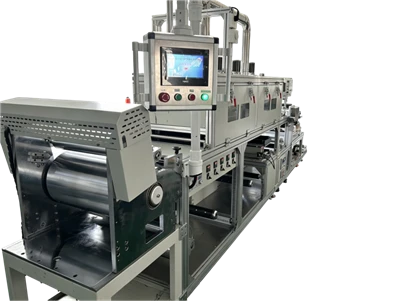
At INNATE, we develop customized coating equipment for different slurry properties, substrates, coating methods, and process requirements. If your formulation contains ceramic particles, inorganic fillers, or other functional solids, sharing your material properties and coating targets can help us evaluate a suitable equipment configuration for laboratory trials, pilot-scale development, or production.
Contact INNATE to discuss your coating process and equipment requirements.