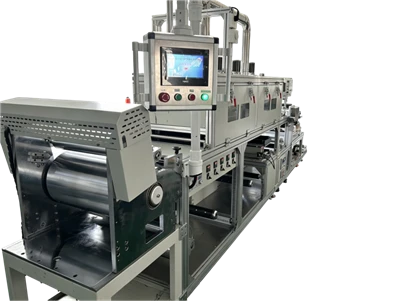

A roll comes off the oven. You cut a metre and measure five points across it. The middle reads low and the two edges stand high. Run a different slurry and the shape holds, with the height moving a little. This is no longer a stray reading. It is the profile the machine holds on an ordinary day. In English literature it shows up as Edge Thick, Center Thin. What plants report usually falls into these four patterns.
1. The centre never reaches the target, and both edges sit over it.
2. So much edge is trimmed, and the yield still will not come up.
3. Tracking has been corrected and the air adjusted, and the shape stays.
4. Change the product or the slurry, and the edge profile changes with it.
Battery electrodes, optical films, release liners, copper and aluminium foil all count as high precision work. The extra thickness at the rim shows up first at slitting and stacking, then in the yield figure. Edge trim is paid for by the millimetre, so a wider trim is a real cost.
So where does the shape come from, and what do you do about it.
Edge Pull-Back Squeezes the Slurry Together Along Both Sides
When thickness comes out uneven, the first move for most people is to go back and measure the metering point. Measure it again and again, and the direction is wrong. Thick edges come from what happens after the slurry leaves it.
Pull-back comes from surface tension. The liquid surface has no support at the edge, so surface tension draws it inward. Slurry is squeezed together at the rim and the wet film runs thicker there than in the middle. The slower the line runs, the longer that pull has to work and the taller the ridge grows.
Where the station has an edge dam, the slurry is held back and there is less room to pull in.
There is a crude check on site. Run a wet film gauge across five points before the oven, and the edge term shows up early. You do not have to wait for slitting, or for finished roll data.
Whether a coating line supplier offers an edge dam, and which kind, shows up in the readings.
Air Runs Faster Along Both Sides of the Oven
Drying is the larger of the two. Solvent leaves the edges faster, air wraps the rim, and velocity lifts along both sides. The edge coating concentrates first and sets first, while the middle is still thin and still free to flow. Solids from the centre are carried outward and settle at the edge.
Leave a cup of coffee to dry and a dark ring forms around the base. Same reason. Much of the extra thickness at the rim comes from this. An uneven temperature profile across the width pushes the same way.
To see what that section is doing, log the temperature of every oven zone, then walk an anemometer across the air outlets. Put the two sets of numbers side by side and the zone causing trouble usually shows up.
So how many days on commissioning will a maker who cannot put a measurable figure on air uniformity cost you? An equipment supplier usually holds the original drying curves, and the cross-web air distribution is written into them. A coating machine manufacturer who builds this into the drying plan leaves less for the crew to fix on site.
Tracking Drift and Uneven Cross-Web Tension
Tracking follows the machine. Drift slightly off centre and the edge on one side enters the oven at a different point and meets different air. Uneven tension across the width changes how the edges shrink. Adjust the web position once and the readings move.
One correction moves the number, so would you treat this term as a constant? The accuracy a machine builder builds into the web guide sets how large it gets.
The Substrate Itself Runs Thick at the Edge
One thing to settle before anything else. Take an uncoated length of substrate and measure the same five points. Foil and film run slightly thick at the edge after calendering and slitting. The coating copies the shape underneath it, so part of that rise was never the coater's doing.
Keep a length of the same roll uncoated, or run the base web across five points and set the figures against the finished roll. A manufacturer who attaches a measured edge tolerance sheet at delivery removes half of these arguments.
Take the substrate term out first. What is left belongs to the coating.
How to Identify the Real Cause
Do not start by touching the ductwork. Three steps in order usually narrow it down.
Measure the uncoated substrate first. Five points across the web, set against the finished figures. Take out the part that was already there, and the rest has something to work with.
Then measure ahead of the oven. Five points on the wet film, a little downstream of the metering point. If the edge is already thick, look at the pull-back term and the edge dam. Rule that out and the search moves into the oven.
Last, measure after the oven. Wet film even going in, dry film uneven coming out, and the direction sits in the drying and tracking section.
Three steps in, and the direction is usually clear. The sampling points need fixing too. A coating line manufacturer's handover profile often carries three points only, with the centre taken as an average. To see the edge itself, the point has to sit within a dozen millimetres of the trim line. That distance is written differently from one maker to the next, so it only counts once it is in the agreement.
What matters after that is who stays with you on it. Does a coating machine manufacturer keep a process team, or only ship equipment? A supplier with no process engineers usually hands you a parameter sheet and leaves the rest to you.
How to Improve Edge Thickness Uniformity
Improvement has to cover the whole coating system. Swapping one part rarely settles it.
On the process side there are several routes. Add edge trimming hardware, or profile the cross-web flow so the edges receive less. Adjust the edge air in the ductwork so the two sides are not lifted. Check the web guide on a schedule, especially the tension distribution across the width. Of the three, the ductwork change is the cheapest and the one most often skipped.
On the equipment side, ask three questions at selection. Can edge air be controlled on its own, and to what degree. Is there room to profile the cross-web flow at the outlet. How many points does the gauging head read, and how far is the outermost point from the trim line.
Write three items into the agreement. How much edge is trimmed, how substrate tolerance is handled, and whether you measure wet or dry film. With those fixed, both sides read the same scale. An equipment supplier should name the measurement points on the acceptance sheet too, so nobody measures a different thing on handover day.
The slurry comes last. A formulation with high surface tension and high solids pulls back harder and shows a heavier edge effect. Change the formulation and the edge profile on the same machine changes with it. That is why an OEM will insist on a trial run with your slurry before quoting. A quote with nothing but a price on it usually has nothing behind it.
Whether a machine builder lists these rows takes one reading of the proposal. A coating line supplier who hands over a cross-web profile at the trial stage gives you something to compare before the machine ships.
Conclusion
A coating that runs thick at the edges and thin in the middle is seldom caused by one thing. Pull-back, drying air, tracking and tension, and the substrate underneath all tend to stack together.
Battery electrodes run wide, and the waste edge goes straight into the yield figure. An OEM usually writes edge tolerance into the technical agreement as a separate line. After slitting the edges stand proud on the roll, and that shows up again at stacking. On this class of work, open the drying section first. Optical films and release liners run thin, and the edge effect takes a larger share of the total. Measure the wet profile before the oven. Copper and aluminium foil carry a large edge tolerance to begin with, so take the calendering and slitting term out before you read the coating.
Stable production needs material analysis, process testing and equipment design to line up. Putting material down is only the entry bar. Holding the same cross-web tolerance two and three years in is what counts.
Edge tolerance comes down to the trim figure, the edge air, and the kind of edge dam. Whether a coating machine manufacturer will run a cross-web profile on your slurry before selection is a fair question. Attach the edge readings and the answer carries more weight. Uneven edges like this come up often in custom work, and precision, thickness and uniformity are worked out against your slurry and your target thickness. The before-and-after data a coating line manufacturer leaves at commissioning exists for exactly this. A coating line supplier who prices the wider waste edge into the quote gives you a complete yield figure.
The first three months after the line arrives test people more than the day the contract is signed. Whether a machine builder stays with you to production is usually clear by then.

A photovoltaic battery coater built by Innater

A small lithium battery coater built by Innater
Published by Innater Intelligent Equipment Co., Ltd, a maker of non-standard coating machines and automated lines. Email 13316631159@163.com | Website https://www.getinnater.com/ | Tel +8613316631159