I. A technology "stuck for 200 years" just broke through
In early 2026, the Ningbo Institute of Materials Technology & Engineering of the Chinese Academy of Sciences and Shanghai Pangu Power announced a landmark: the axial flux motor achieved ten-thousand-unit mass production and delivery for the first time. The axial flux motor, whose prototype dates back to Michael Faraday in 1821, has long been regarded as the ultimate form of electric motor for its inherent advantage of "halving both volume and weight at the same power" - yet it remained confined to the laboratory for two centuries. Now that it has broken through, a chain reaction of material and equipment upgrades follows - and the amorphous motor core is the pivotal arena of that upgrade.
II. The market is moving - the numbers don't lie
Consider a few figures:
Amorphous alloy for motor cores: global revenue reached about RMB 111 million in 2025, projected to approach RMB 266 million by 2032, a 13.2% CAGR from 2026 to 2032. Global output hit 6,661 tons in 2025, at an average price of USD 2,338 per ton.
By another estimate, the global amorphous-alloy-for-motor-core market was roughly USD 81 million in 2024, reaching USD 177 million by 2031, an 11.5% CAGR.
Penetration of low-iron-loss soft magnetic materials in automotive drive motors has already surpassed 12%, up 7 percentage points year over year.
China's installed motor base is about 4 billion kW, consuming 4.8 trillion kWh - 64% of the nation's total electricity. Every 1-percentage-point gain in motor efficiency saves 26 billion kWh per year.
Why is the amorphous core attracting so much attention? In one sentence: amorphous alloy's iron loss is more than 70% lower than conventional non-oriented silicon steel, an advantage that becomes especially pronounced at high frequency and high speed. NEV drive motors, high-efficiency industrial fans and pumps, humanoid robot joints, low-altitude aircraft - every application sensitive to power density and energy consumption is turning its attention to amorphous cores.
Downstream, the "inflection point" has already arrived: Pangu Power has built the world's first large-scale axial-flux-motor production line with a 300,000-unit-per-year base; NBTM's subsidiary Xiaoxiang Electric sold 4,843 axial flux motors in 2025, up 103.49% year over year, and has entered the humanoid-robot and NEV supply chains of Huawei, BYD, and GAC.
Upstream, the materials side has consolidated as well: AT&M, Proterial (formerly Hitachi Metals, Metglas™ brand), Qingdao Yunlu, and Jiangsu Guoneng Alloy together hold 97.72% of global revenue for amorphous alloy used in motors - with AT&M alone at 50.72%.
III. The overlooked truth: whether amorphous cores can scale comes down to "coating"
Most attention goes to "melt spinning" - the rapid solidification that produces the amorphous ribbon itself - while a more critical, more hidden manufacturing step is overlooked: the coating of insulation layers.
Amorphous ribbon is only 20–50 μm thick - brittle and thin. Turning it into a motor core requires solving three tightly interlocking problems:
1. Interlaminar insulation - otherwise the core "breaks down" directly at high frequency. Although amorphous alloy has high resistivity, as frequency rises, eddy-current loss amplifies rapidly. Without a uniform insulation layer between laminations, pulsed high voltage causes interlaminar breakdown and the core is scrapped. Industry research provides hard data: increasing the coating thickness on amorphous ribbon from 2 μm to 10 μm raises the withstand voltage from 26 V to 122 V - the insulation coating is the lifeline of amorphous cores' high-frequency performance.
2. The coating must be ultra-thin, uniform, heat-resistant, and non-degrading to magnetic properties. Too thick an insulation layer introduces air gaps and lowers permeability; too thin and insulation is insufficient. The ideal thickness is 1–2 μm, with accuracy on the order of ±0.2 μm. The coating must also withstand stress-relief annealing at 350–400°C, match the amorphous material's coefficient of thermal expansion, and offer high thermal conductivity and good adhesion - fail any one of these, and the coating will peel or degrade magnetic performance during annealing.
3. Tension control for continuous coating of brittle, thin ribbon. A brittle 20–50 μm ribbon, handled carelessly in continuous coating, will break, wrinkle, or scratch. This demands precision control across the entire chain - tension, web handling, doctoring, and drying.
These three hurdles all land squarely on "coating technology." And this is not our speculation - it is an industrial fact repeatedly verified by patents and production lines:
AT&M's core patent CN102510141A, Amorphous alloy stator core for axial flux motors and its manufacturing method, explicitly states: after slot-punching, the amorphous ribbon is dip-coated with an insulation coating liquid, the excess coating removed by a doctor blade, and then wound into a core.
CN105119448B, Varnish-impregnation and curing method for laminated amorphous motor stator cores, uses a spin coater to spin epoxy resin for impregnation, thickness control, and curing.
CN103128039A, Coating method for insulation coating on wound amorphous cores, describes the full process of epoxy adhesive impregnation + vacuum impregnation + heat curing.
Another patent discloses an inorganic, heat-resistant bonding system for double-sided coating of amorphous ribbon (SiO₂/Al₂O₃/ZrO₂/SiC + silane coupling agent), dried at 60–120°C.
For the powder route, CN114334347A, High-frequency low-loss amorphous soft magnetic composite film material, adopts amorphous powder + resin + coupling agent → tape casting into a film → hot pressing - and "tape casting" is itself a branch of coating technology.
In one sentence: mass-producing amorphous cores is, at its core, a competition of coating technology. Whoever can apply an insulation layer that is thin, uniform, and non-damaging to the material holds the entry ticket to this race.
IV. Innate: we are ready
Facing this just-opened blue ocean of amorphous motor core coating, Innate (Dongguan Innate Intelligent Equipment Co., Ltd.) has a direct answer: we can do it.
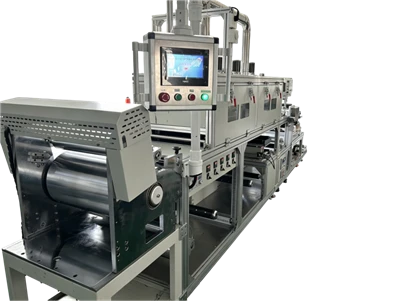
Full coverage of coating methods: micro-gravure, slot-die, comma doctor blade, anilox roller, extrusion, and other precision coating processes - matched to the viscosity, thickness, and speed requirements of amorphous-core insulation coatings. From ultra-thin 1–2 μm insulation layers to 500 μm-level composite adhesive layers, we have a coating-head solution for each.
Web-handling experience with brittle, thin substrates: for easily torn or wrinkled 20–50 μm amorphous ribbon, copper foil, aluminum foil, and similar substrates, we have proven closed-loop tension control and web-guiding capability - an essential prerequisite for continuous amorphous-ribbon coating.
Customized delivery capability: amorphous-core coating systems (inorganic silicates, sol-gel SiO₂/TiO₂/ZrO₂, epoxy/phenolic/silicone resins) vary enormously. We tailor the coating head, drying section, and unwinding/rewinding scheme to the customer's slurry viscosity, solids content, and curing temperature - and provide complete validation from sampling to mass production.
Serving two major process routes:
Ribbon route - double-sided insulation coating machines for amorphous ribbon, and varnish-impregnation/spin-curing equipment for amorphous cores;
Powder route - tape-casting machines for amorphous/nanocrystalline magnetic-powder slurry, and insulation-coating equipment for soft magnetic composites (SMC).
In one sentence: the "insulation coating" hurdle of amorphous motor cores - we'll help you clear it.
V. Who should talk to us
If you are in any of the following positions, bring your process requirements and let's talk:
Motor manufacturers / NEV OEMs: importing or evaluating amorphous cores, axial flux motors, or high-efficiency drive motors;
Magnetic material / amorphous ribbon makers: needing ribbon insulation coating, double-sided coating, or self-bonding coating;
Magnetic powder core / SMC makers: needing powder insulation coating or slurry tape-casting;
Research institutes / university pilot lines: needing small-batch R&D coating equipment.
From a single strip of amorphous ribbon to a motor core that can go into a vehicle - that thin, uniform insulation film in between is precisely what we do best.