
1. Why Are There Bubbles in Your Coating Slurry?
Bubbles in coating slurry are a common problem in coating production. They may appear during mixing, material transfer, or the coating process itself.
When the slurry is applied to a substrate, trapped air can remain inside the wet coating. During drying, these bubbles may expand or break, leaving pinholes, small craters, and uneven areas on the coating surface.
For some materials, a small number of bubbles may not cause serious problems. But for functional films, battery materials, optical films, adhesive coatings, and other applications with strict surface requirements, even small defects can affect product quality.
The first thing to find out is where the bubbles come from. Simply adjusting the coating speed or changing the coating head may not solve the problem if air is already present in the slurry.

2. What Causes Bubbles in Coating Slurry?
There is usually more than one possible cause. The following are some common situations we encounter when working with coating processes.
2.1 Air Entrained During Mixing
High-speed mixing can introduce air into the slurry, especially when the mixing blade creates a vortex or the liquid level is too low.
Some high-viscosity materials are more difficult to release trapped air. The bubbles may stay inside the slurry for a long time instead of rising to the surface.
Possible solutions:
Adjust the mixing speed and mixing method.
Avoid creating a deep vortex during mixing.
Keep the mixing blade properly positioned.
Allow sufficient time for bubbles to rise before coating.
Consider vacuum mixing or a separate vacuum degassing process when necessary.
The mixing process should be adjusted according to the slurry viscosity, solid content, and material characteristics. Increasing the mixing speed does not always improve the result.
2.2 Insufficient Vacuum Degassing
Some coating materials contain a large amount of trapped air after mixing. Normal standing or low-speed stirring may not be enough to remove it.
This is more noticeable with high-viscosity slurry because bubbles move slowly through the material.
A vacuum degassing system can reduce the pressure above the slurry, allowing trapped bubbles to expand and escape more easily.
Possible solutions:
Select a vacuum system suitable for the slurry volume and viscosity.
Set the vacuum level and degassing time according to the material.
Avoid excessive foaming during the process.
Check whether the slurry changes after vacuum treatment.
Vacuum treatment needs to be tested with the actual material. Some formulations may foam or lose volatile components under excessive vacuum. The vacuum level should therefore be selected based on the material and process requirements.
2.3 Air Entering Through the Slurry Feeding System
Even when the slurry has been properly degassed, bubbles can appear again during material transfer.
Common reasons include:
Loose connections in the feeding pipeline.
Air leakage on the suction side of the pump.
An unsuitable pump operating condition.
Unstable material supply.
Low material levels in the storage tank.
Air trapped in pipeline bends or dead zones.
This problem is sometimes overlooked. The slurry may look fine in the mixing tank, but bubbles appear again before reaching the coating head.
Possible solutions:
Check pipeline connections and sealing conditions.
Make sure the pump is suitable for the material viscosity.
Avoid air entering from the pump inlet.
Maintain a stable material level in the tank.
Check the feeding pipeline for areas where air can accumulate.
For precision coating, stable slurry feeding is just as important as the degassing process. Removing air from the slurry is only part of the job. It is also necessary to prevent air from entering again during transfer.
2.4 Improper Coating Parameters
Sometimes the slurry itself is not the main problem. The coating process may also introduce or expose bubbles.
For example, unsuitable coating speed, coating gap, material supply rate, or slurry flow conditions may lead to an unstable coating layer.
With slot die coating, an unstable feeding rate or unsuitable die conditions may affect the coating bead. With doctor blade coating, poor material flow and unsuitable coating parameters may cause surface defects.
Possible solutions:
Match the feeding rate with the coating speed.
Check the coating gap and coating head position.
Adjust the slurry flow to maintain a stable coating bead.
Test different coating speeds to find a suitable operating range.
Check whether the problem occurs across the full coating width or only in certain areas.
Changing one parameter at a time makes it easier to identify the actual cause.
2.5 Poor Wetting Between the Slurry and Substrate
Bubbles and small holes on the coating surface are not always caused by air trapped inside the slurry.
Poor substrate wetting can also produce similar defects. This may happen when the substrate surface energy is too low, the material is contaminated, or the slurry and substrate are not compatible.
Possible solutions:
Check the substrate surface condition.
Confirm that the substrate is clean and suitable for the coating material.
Evaluate whether corona or plasma treatment is required.
Check the compatibility between the slurry and substrate.
Adjust the formulation or coating conditions if necessary.
Before changing the coating machine, it is worth confirming whether the slurry can wet the substrate properly.
2.6 Bubbles or Pinholes Formed During Drying
A coating may look normal immediately after application, but defects appear after entering the oven.
This can happen when solvents or other volatile components evaporate too quickly, or when the drying temperature is not suitable for the material.
If the surface dries too quickly while the inside still contains solvent, gas may have difficulty escaping. This can result in pinholes, craters, or other surface defects.
Possible solutions:
Review the temperature settings in each drying zone.
Adjust the drying speed according to the solvent evaporation characteristics.
Check the airflow and exhaust conditions.
Avoid excessive heating at the beginning of the drying process.
Test the complete coating and drying process together.
The oven temperature should not be considered separately from the coating material, wet film thickness, and production speed.
3. How to Identify Where the Bubbles Come From
Before changing the equipment or process parameters, it is better to locate where the bubbles first appear.
A simple inspection can help narrow down the problem.
| Inspection Point | What to Check |
|---|---|
| Mixing tank | Are bubbles already visible after mixing? |
| Storage tank | Does the slurry still contain trapped air after standing or degassing? |
| Feeding pipeline | Are there loose connections, air leaks, or unstable material flow? |
| Before coating head | Does the slurry contain bubbles before entering the coating head? |
| Wet coating surface | Do bubbles appear immediately after coating? |
| After drying | Does the wet coating look normal but develop pinholes or craters after drying? |
This inspection helps distinguish between bubbles introduced during mixing, air entering through the feeding system, coating-related problems, and defects formed during drying.
It is important to identify the source before making adjustments. Otherwise, changing several parameters at the same time may make the problem harder to solve.
4. What Equipment Can Help Reduce Bubbles in Coating Slurry?
The equipment required depends on the material and where the bubbles are introduced. A coating machine alone cannot remove all the air already trapped inside the slurry.
4.1 Vacuum Mixing and Degassing System
A vacuum mixing and degassing system can help remove trapped air from coating materials before they enter the coating machine.
It is particularly worth considering for high-viscosity materials, functional slurry, adhesive formulations, and materials that are difficult to deaerate under normal conditions.
The system may include:
Mixing tank
Vacuum chamber or vacuum cover
Agitation system
Vacuum pump
Pressure monitoring
Material discharge system
The tank volume, mixing structure, vacuum level, and processing time should be selected according to the material and production requirements.
<em>Image caption: Vacuum Mixing and Degassing System for Coating Slurry</em>

4.2 Stable Slurry Feeding System
After degassing, the slurry needs to be transferred to the coating head without introducing additional air.
A suitable feeding system helps maintain stable material delivery during coating.
Depending on the slurry characteristics, the system may include a storage tank, feeding pump, filter, pipeline, and pressure monitoring components.
For high-viscosity materials, pump selection and pipeline design need particular attention. A feeding system that works well with low-viscosity liquids may not be suitable for a thick or particle-filled slurry.
4.3 Slot Die Coating Machine
Slot die coating is suitable for applications that require controlled coating thickness and stable material delivery.
The slurry is supplied through a pump to the slot die, where it is distributed across the coating width.
For materials that require precise coating control, the feeding system, pump, die design, coating gap, and substrate speed need to work together.
Slot die coating does not remove bubbles from the slurry. However, a properly designed coating and feeding system can help reduce process-related instability.
4.4 Doctor Blade Coating Machine
Doctor blade coating is commonly used for laboratory testing, pilot production, and functional material coating.
It can accommodate different slurry formulations and is useful for evaluating the relationship between viscosity, coating gap, speed, and wet film thickness.
For materials that contain particles or have relatively high viscosity, the blade structure and material feeding method need to be selected according to the slurry characteristics.
4.5 Roll-to-Roll Coating Machine
For continuous production, the coating machine needs to work with the feeding, tension control, coating, and drying systems.
If bubbles are caused by unstable material supply or unsuitable coating conditions, the complete production line should be checked rather than focusing only on the coating head.
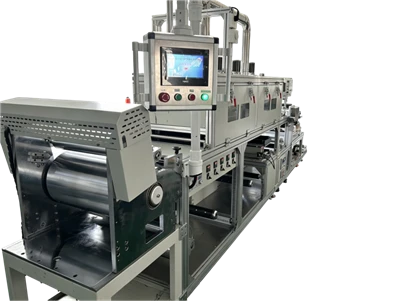
A customized roll-to-roll coating machine can be designed around the material, substrate, coating method, drying requirements, and production speed.
5. How to Choose the Right Coating Machine?
Different slurry materials require different coating methods. Viscosity is an important factor, but it is not the only one.
Before selecting a coating machine, it is useful to understand:
Slurry viscosity and solid content.
Whether the material contains particles or fillers.
Whether the slurry is water-based or solvent-based.
Substrate material and width.
Required wet and dry coating thickness.
Required coating speed.
Drying or curing conditions.
Whether vacuum degassing and automatic feeding are needed.
For example, a high-viscosity adhesive slurry may need a different feeding and coating arrangement from a low-viscosity functional coating material. A particle-filled slurry also requires attention to filtration, pump selection, and the flow path.
The coating method should be selected according to the actual material and process requirements, not simply based on the machine's maximum speed or coating thickness range.
6. Customized Coating Machine Solutions from INNATE
INNATE designs and manufactures customized coating machines for laboratory testing, pilot production, and industrial coating applications.
We do not assume that every coating problem can be solved by changing the coating head. In many cases, the mixing, degassing, feeding, coating, and drying processes need to be considered together.
Depending on the project, the equipment can be configured with:
Doctor blade coating
Slot die coating
Micro-gravure coating
Roll-to-roll web handling
Customized material feeding systems
Multi-zone drying ovens
Lamination and winding units
For projects involving bubbles in coating slurry, we can review the material characteristics and existing process conditions to help identify which parts of the system need attention.
The final configuration depends on the material, substrate, coating requirements, and production conditions.
7. What Information Is Needed to Evaluate Your Coating Process?
If you are experiencing bubbles, pinholes, or uneven coating surfaces, the following information can help us understand the problem:
What type of slurry or coating material are you using?
What is the viscosity and solid content?
Does the material contain particles or fillers?
What substrate are you coating?
What are the required wet and dry coating thicknesses?
At what production speed does the problem occur?
Do bubbles appear in the mixing tank, feeding pipeline, wet coating, or after drying?
Are you currently using vacuum degassing?
Photos or videos of the slurry and coating defects are also helpful.
With this information, we can better understand the process and discuss a suitable coating machine configuration.
Conclusion
Bubbles in coating slurry can come from mixing, insufficient degassing, material feeding, coating conditions, substrate wetting, or drying.
The key is to identify where the bubbles enter the process before making adjustments.
Vacuum degassing can help remove trapped air, while a stable feeding system can prevent air from entering again. The coating head, coating parameters, and drying conditions also need to match the material.
If you are facing bubble-related coating defects, INNATE can help review your material and process requirements and develop a suitable customized coating solution.