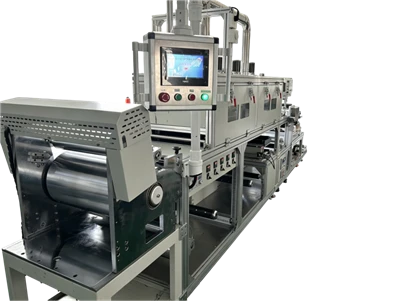

Your slurry is 10,000 cP, 15,000 cP, or maybe even higher. For the coating, it is a headache problem that troubles customers.
During coating, the pump is running while the flow keeps fluctuating. Streaks appear even though the coating head looks clean. You feel confused and don't know why the coating works at low speed but still becomes unstable when the line speed increases. The center is thicker than the edges. The wet film looks acceptable, but the dry film is no longer uniform.
Many engineers will ask: "Is the slurry simply too viscous to coat?"
The answer is Yes and high-viscosity slurry can be coated. The real challenge is achieving stable, uniform and repeatable coating at the required thickness and production speed.
If you are sourcing a high-viscosity coating machine or scaling a laboratory formulation to pilot or mass production, do not send a supplier only one number: viscosity.
Now Customers face five problems
Why Is the Material Flow Unstable?
The first reaction is often to increase pump pressure. But higher pressure does not automatically mean better coating stability.
High-viscosity slurry experiences pressure loss through the pump, filter, piping, valves and coating head. If any part of the feeding system is mismatched, the flow entering the coating head may fluctuate.
Check first:
Pump suitability for viscosity and rheology
Pipe diameter and excessive pipe length or bends
Filter pressure drop
Material temperature stability
Pump pulsation and its effect on coating flow
For high-viscosity coating, stabilizing the feeding system may be more important than changing the coating head.
2: Why Is the Coating Thicker in the Center and Thinner at the Edges?
This is a common concern in precision coating. The die may be responsible, but the cause can also be upstream in the feeding system or downstream in the substrate.
Uneven transverse pressure distribution
Die flow-channel mismatch
Incorrect die-lip adjustment
Uneven material supply
Web tension or flatness problems
Changes in slurry rheology
Do not immediately modify the die lip. First identify where the thickness variation begins.
3: Why Does It Work at Low Speed but Fail at High Speed?
This is a typical scale-up problem. A coating process may be stable at 2 m/min but develop streaks, flow instability, thickness variation or edge problems at a higher speed.
When line speed changes, required material flow, shear conditions, coating transfer, wet-film behavior and drying load also change.
A machine that runs at low speed is not automatically a production-ready coating line.
For scale-up projects, a laboratory or pilot coating machine can help establish a stable Process Window before a Production Coating Line is designed.
4: Why Are There Streaks?
Streaks are not always caused by insufficient die precision.
Particles or agglomerates
Insufficient filtration
Die contamination
Unstable material flow
Excessive or unsuitable shear
Unstable substrate surface
Replacing the coating head without checking the material and feeding system may not solve the real problem.
5: Why Does the Coating Look Good Wet but Uneven After Drying?
The problem may be in the Drying Process rather than the coating section.
Solvent evaporation, wet-film leveling, temperature distribution, air velocity and oven residence time can all affect the final dry film. High-viscosity materials may require particular attention to flow and shrinkage during drying.
A complete Coating System should therefore be evaluated from Material Feeding through Drying, not only at the Coating Head.
Which Coating Method Is Suitable?
There is no universal coating method for every high-viscosity slurry. Selection should consider material rheology, wet thickness, substrate, line speed and required accuracy. In the following I will introduce three coating methods.
Slot Die Coating
Slot die coating can be suitable for many functional coating applications requiring controlled thickness and continuous production. Selected high-viscosity slurries can also be processed when rheology, feeding pressure, flow rate and die design are properly matched.
The key question is not "Can a slot die coat high-viscosity slurry?" but "Has the die been designed for your Material Rheology and Flow Rate?"
Knife Coating
Knife coating can be considered for adhesives, thick coatings and selected high-viscosity materials. The structure is relatively straightforward, but final thickness and surface quality still depend on the material and process window.
Roll Coating
Gravure, micro-gravure, reverse-roll and other roll coating methods may also be suitable for selected high-viscosity materials. Material transfer, roll-speed ratio, solids content, target thickness and substrate condition should be evaluated.
Don't Tell a Supplier Only '15,000 cP'
For a serious Custom Coating Machine project, viscosity alone is not enough. Provide:
Viscosity and test temperature
Solids Content
Density
Rheology
Wet Coating Thickness
Dry Coating Thickness
Coating Width
Target Line Speed
Substrate type, width and thickness
Solvent type
Target production capacity
Single-side or double-side coating
These parameters affect the complete Coating Equipment configuration, not just the coating head.
Why Flow Rate Matters
Equipment selection should consider how much material must be delivered per unit of time.
A basic relationship for preliminary estimation is:
Required Flow Rate ≈ Coating Width × Wet Thickness × Line Speed × Material Density
As width, wet thickness or line speed increases, required flow rate also increases. With high-viscosity slurry, this can significantly affect pump pressure, piping pressure loss, filter pressure loss and die pressure distribution.
This is why the same 15,000 cP slurry may be manageable on a small low-speed machine but much more difficult on a wide, high-speed production line.
When Should You Run a Laboratory or Pilot Coating Trial?
Consider pilot testing when:
The material is new to continuous coating
Viscosity exceeds the current equipment capability
A thin coating is required from a highly viscous slurry
High transverse thickness accuracy is required
Laboratory results are difficult to scale up
Target production speed is much higher than the current test speed
A Laboratory Coating Machine or Pilot Coating Machine is not simply for making samples. Its value is in establishing a stable Process Window and reducing the risk of directly purchasing a production line.
What Should You Ask a Coating Machine Supplier?
Have you handled materials with a similar viscosity range?
What material parameters do you need besides viscosity?
Which feeding pump do you recommend, and why?
How should the filtration system be configured?
Will the coating head be designed around my slurry?
Should we run a Pilot Trial before confirming the production machine?
How would you troubleshoot center-thick / edge-thin coating?
How would you establish a process window if low-speed coating is stable but high-speed coating is not?
Can the equipment be scaled from laboratory/pilot to production?
How will coating quality and production stability be validated before mass production?
How We Approach High-Viscosity Coating Projects
As a Custom Coating Machine Manufacturer, our focus is not simply supplying a machine. The goal is to help customers achieve stable production.
Our technical evaluation follows:
Material → Feeding → Filtration → Coating → Web Handling → Drying → Rewinding
Material and rheology evaluation
Pump and piping design
Filtration-system matching
Slot die / knife / roll coating selection
Web tension and handling design
Drying and curing evaluation
Laboratory or pilot validation
Production coating-line configuration
For non-standard materials, we do not simply apply a standard machine configuration. The equipment should be developed around the customer's Material, Coating Target and Production Requirements.
Conclusion:
The 15,000 cP slurry can be coated. But the real question is whether it can be coated consistently at your target thickness, width and production speed.
If you are experiencing unstable flow, streaks, center-thick/edge-thin coating, low-speed success but high-speed failure, or dry-film thickness variation, do not immediately conclude that the slurry is simply too viscous.
Check the complete system: material, feeding, filtration, coating head, web handling and drying.
If you are developing a high-viscosity coating process or looking for a High-Viscosity Coating Machine, send us:
Viscosity + Solids Content + Wet Thickness + Coating Width + Substrate + Target Speed
Our engineering team can help evaluate the Coating Method, Feeding System, Coating Head and Laboratory / Pilot / Production equipment configuration.
Let's start with your material - not with a standard machine.